
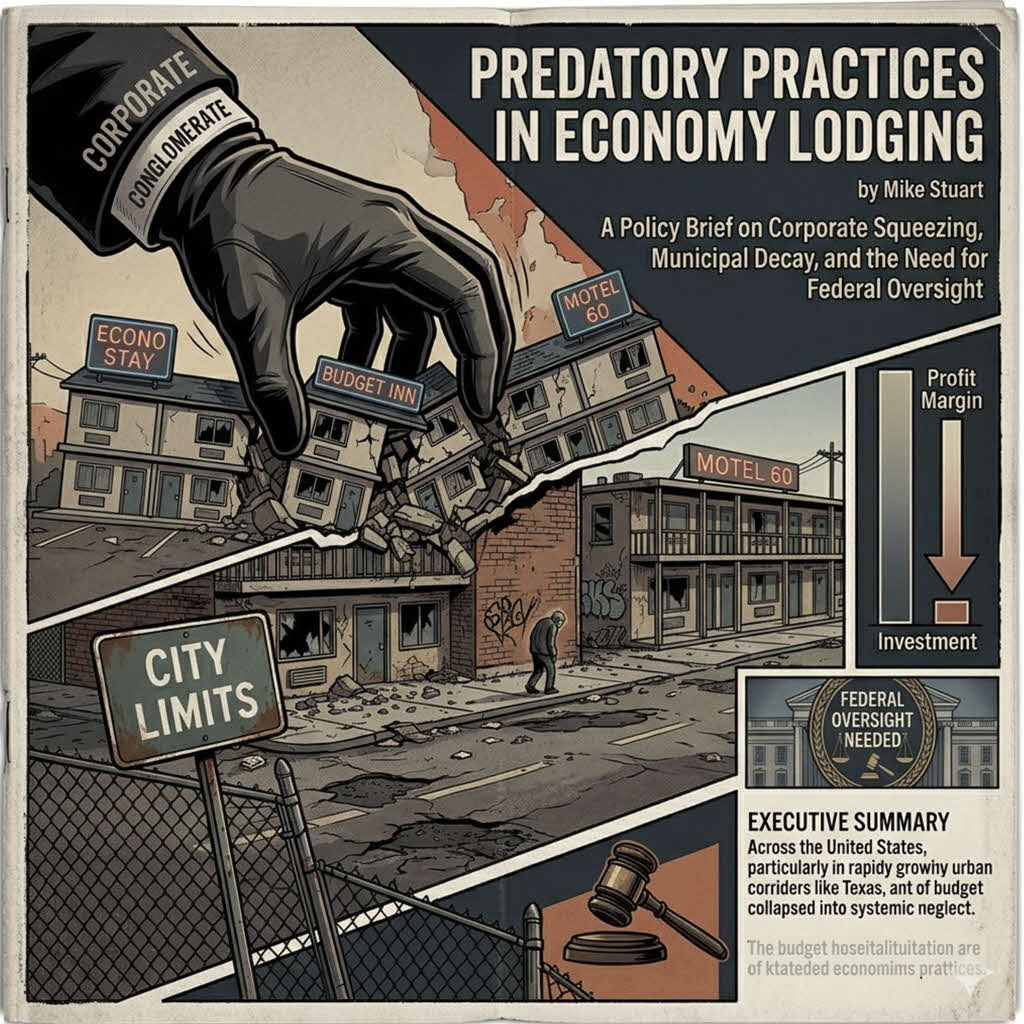
A Policy Brief on Corporate Squeezing, Municipal Decay, and the Need for Federal Oversight
Executive Summary
Across the United States, particularly in rapidly growing urban corridors like Texas, a critical segment of the budget hospitality tier has collapsed into systemic neglect. Driven by private equity buyouts, asset-light corporate restructuring, and predatory franchise models, iconic budget brands (for example, Motel 6, Studio 6, Super 8, and Quality Inn) are being systematically run into the ground.
By prioritizing short-term extraction over property maintenance and guest safety, institutional owners and global franchisors are trapping economically vulnerable travelers in hazardous conditions. This phenomenon damages local economies, drains municipal resources through nuisance-property dynamics, and requires urgent legislative intervention similar to ongoing bipartisan efforts targeting corporate residential landlords.
1. Core Definitions and Economic Root Causes
Predatory Economy Lodging (“Hell-tels”)
Defined as budget-tier and extended-stay hospitality properties managed under a regime of hyper-extractive capitalism, these properties mirror Wall Street-backed corporate landlord models in the residential housing market. They extract maximum short-term revenue by deferring maintenance, eliminating customer service, and ignoring safety protocols.
The Institutional Squeeze
The degradation of these properties is a direct symptom of institutional financial engineering:
- The “Asset-Light” Shift: Major private equity firms historically acquired corporate-owned budget chains, sold off the underlying real estate for a quick profit, and converted the brands into pure franchise networks.
- The Global Tech-Franchise Model: Recent multi-million dollar acquisitions of major budget brands by global travel-tech conglomerates (such as the acquisition of G6 Hospitality/Motel 6) rely on heavy corporate fee structures and automated dynamic pricing.
- The Franchisee Trap: Local operators—often immigrant families operating on razor-thin margins—buy into these low-tier franchises. Squeezed by high corporate fees and forced into low room rates by corporate algorithms, these onsite operators lack the capital to maintain the properties, leading them to live in the back offices and perform multiple roles out of sheer economic survival.
2. Operational Deficiencies and Deceptive Practices
To maintain occupancy despite severe physical degradation, these establishments rely on systemic operational anomalies and deceptive marketing:
|
Operational Indicator |
Observed Impact on Guests and Community |
|
Algorithmic Review Manipulation |
Exploitation of online travel agencies using bot networks or review-phishing to artificially inflate ratings and lure unsuspecting travelers. |
|
Financial Arbitrage and Non-Compliance |
Demanding cash-only deposits, utilizing predatory lobby ATMs, forcing excessive credit card holds, and enforcing strict no-refund or no-cancellation policies even when rooms are uninhabitable. |
|
Severe Deferred Maintenance |
Pervasive mold, non-functioning or contaminated HVAC units, broken infrastructure, and structural pest infestations such as bedbugs and roaches. |
3. Public Health, Safety, and Nuisance Dynamics
The human cost of predatory economy lodging extends beyond financial deception. It directly compromises public health and strains municipal emergency services.
Health Hazards and Psychological Toll
Travelers economically bound to this price tier, including working-class professionals, relocating families, and project-based workers, face immediate physical and mental health risks:
- Physical Symptoms: Chronic sinus issues, severe headaches, dizziness, nausea from toxic mold/insecticides, and painful insect bites.
- Psychological Impact: Extreme sleep deprivation, heightened anxiety regarding personal safety, and a profound loss of dignity.
The Security Vacuum
By eliminating professional security personnel and on-site management to cut costs, these properties can become municipal nuisance properties:
- Criminal Infrastructure: Open-air drug markets, human trafficking corridors, and localized property crime flourish in unmonitored parking lots.
- Ad-Hoc Permanent Housing: Due to the severe shortage of affordable residential housing, these dilapidated motels increasingly serve as unsafe, high-cost permanent housing for displaced populations, bypassing standard tenant protections and code enforcement.
4. Socioeconomic Impact on Municipalities
The so-called hell-tel model represents an extractive economic drain on host cities, creating localized economic depressions:
- Draining Public Resources: Municipalities face an unsustainable drain on emergency services, with local police, fire, and EMS responding to a disproportionate number of calls at a handful of budget addresses.
- Depreciation of Local Property Values: Crumbling hotel structures serve as visual blight, suppressing economic investment in surrounding commercial zones.
- Loss of Quality Local Jobs: The transition from professional hospitality management to understaffed, exploitative franchise operations wipes out stable local employment opportunities.
- Diminished Tax Revenues: Deteriorating occupancy from traditional business or leisure travelers reduces local hotel occupancy tax (HOT) revenues and harms the city’s broader economic reputation.
5. Legislative Call to Action
The degradation of the budget lodging industry is not a localized market failure. It is a regulatory blind spot. Congress and state legislatures must act across the political aisle to protect consumers and municipalities from corporate hospitality extraction.
Recommended Policy Frameworks
- Bipartisan Hospitality Oversight: Extend federal scrutiny currently applied to corporate residential landlords to institutional hospitality networks and global franchisors.
- Franchisor Accountability Acts: Enact legislation holding parent corporate brands legally and financially liable for chronic code, health, and civil rights violations occurring at their franchised locations.
- Strict Municipal “Nuisance Motel” Ordinances: Empower cities to impose heavy daily fines, mandatory closures, or receivership on properties that exceed a specific threshold of emergency service calls or building code violations.
- Consumer Transparency Mandates: Require verified, independent auditing of online hospitality reviews and strict enforcement of consumer protection laws regarding hidden fees and mandatory cash deposits.
Industry References and Structural Context
- Corporate Consolidation Trends: Global travel-technology platforms and private equity firms continue to acquire and consolidate iconic U.S. economy lodging brands (e.g., the global acquisition of G6 Hospitality/Motel 6 and Studio 6), driving hyper-automated, asset-light management frameworks.
- Municipal Precedent: Cities like Fort Worth, Dallas, and San Antonio have increasingly relied on “Nuisance Abatement Teams” and specialized code enforcement tasks forces to crack down on chronic criminal activity and hazardous living conditions at low-tier extended-stay motels.
Predatory economy lodging is not an isolated hospitality problem. It is a consumer protection, public safety, and municipal accountability crisis. Addressing the rise of these exploitative properties will require coordinated oversight, stronger enforcement, and a clear commitment to protecting both travelers and the communities forced to absorb the costs of corporate neglect.
Predatory lodging and corporate landlords both contribute to rising homelessness by constricting housing supply—one at the high end of the market and the other at the low end. This comes at a time when we need more housing not less.
About the Author
Michael Stuart
Founder and Publisher, Homepit.com
Homepit is a public-interest watchdog project focused on how corporate ownership and Wall Street speculation are reshaping housing, hospitality, and local communities.