
Brookfield Properties is a Canadian multinational real estate company headquartered in Toronto, Ontario, and owned by Brookfield Corporation, one of the world’s largest alternative asset managers.
Brookfield is considered a wall street-backed corporate landlord that develops, owns, and manages hundreds of office towers, shopping centers, and apartment communities across North America, Europe, and Asia.
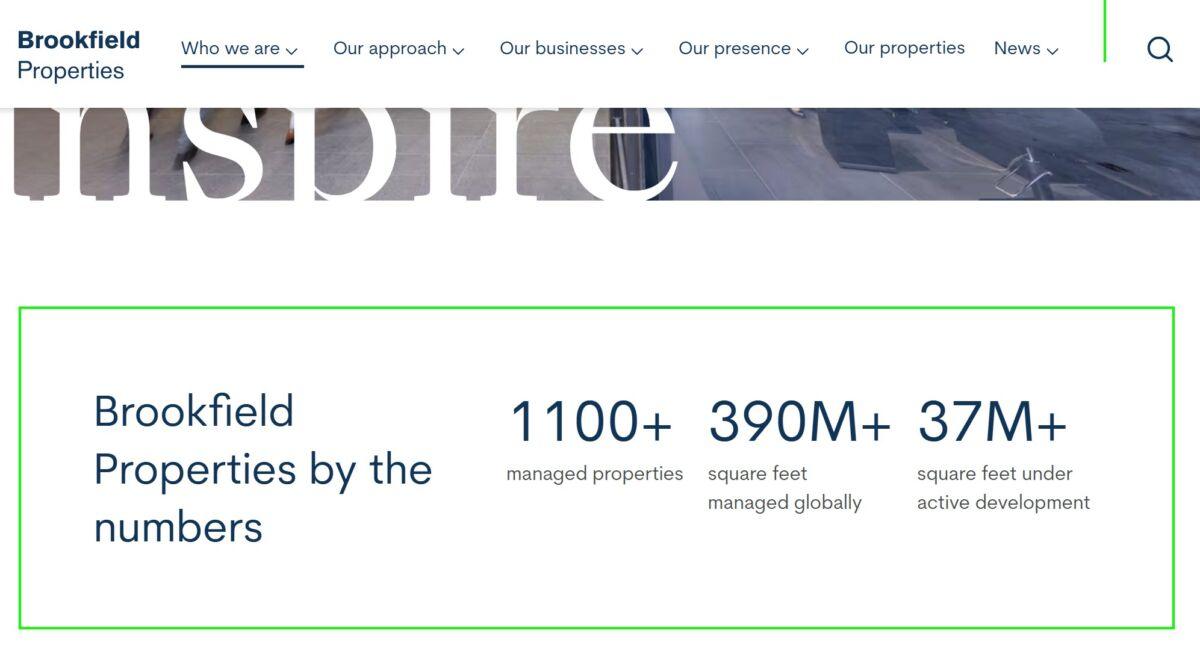
Through its parent company, Brookfield controls more than $850 billion in assets worldwide, making it one of the most influential players in global real estate and infrastructure investment.
In the United States, Brookfield Properties has become one of the largest institutional residential landlords, operating through subsidiaries and affiliates under brands such as Brookfield Residential, Brookfield Properties Multifamily, and Brookfield Asset Management.
The company’s Wall Street–style model uses global capital to acquire large housing portfolios, often financed through real-estate investment trusts (REITs) and private-equity funds.
Brookfield Properties Strategy
Brookfield Properties is a major global real estate firm that fits the description of a Wall Street–backed corporate landlord, but its primary focus has historically been on commercial real estate (office buildings, retail malls). However, it is also a significant and growing investor in residential properties, including single-family rentals.Here’s how Brookfield fits into the discussion
- Institutional Backing: As a subsidiary of Brookfield Asset Management, one of the world’s largest alternative asset managers, it uses global capital to acquire large property portfolios, leveraging a “Wall Street–style model” common to other corporate landlords.
- Diverse Portfolio: Unlike companies focused solely on single-family homes (like Invitation Homes), Brookfield’s portfolio is vast and diverse, spanning office, retail, logistics, hospitality, and various types of housing (multifamily, single-family, student, senior).
- Single-Family Rental Presence: Brookfield has made a deliberate entry into the single-family rental market. In 2020, it raised a specific fund to invest in single-family rentals and acquired a controlling stake in Conrex, a landlord operating in the Midwest and Southeastern U.S. Through its various real estate platforms, Brookfield owns and manages a portfolio that includes approximately 19,000 single-family rental homes, in addition to 80,000 multifamily units.
- Value-Add Strategy: Its strategy involves acquiring high-quality or distressed assets, investing on a value basis, and enhancing value through active management. This sometimes includes redeveloping properties, such as turning parts of mall properties into “mini cities” that incorporate residences.
In short, Brookfield is a significant institutional player that uses large-scale investment capital to operate across the entire real estate spectrum, including a notable and expanding footprint in residential and single-family rental markets.
Critiques of Brookfield Properties
Critiques of Brookfield Properties’ management style largely focus on a profit-first approach that allegedly leads to poor tenant relations, inadequate maintenance, and opaque fee structures. Key critiques from tenants and employees include:
- Excessive and Hidden Fees: Residents report being charged “junk fees” and being over-billed for utilities, sometimes for landlord-controlled common areas. A class-action lawsuit was filed against the company for allegedly using deceptive “drip-pricing” schemes and illegal fees.
- Poor Maintenance and Slow Responses: Tenants frequently complain about significant and recurring maintenance problems (e.g., non-working elevators, plumbing issues, lack of heat/hot water for extended periods) that are not addressed in a timely or sufficient manner. The corporate structure is described as disincentivizing repairs by basing maintenance managers’ bonuses on money saved, not tenant satisfaction.
- Lack of Communication and Accountability: Tenants struggle to reach management, often being redirected to AI assistants or automated systems, making it difficult to resolve issues or get clear answers.
- Deteriorating Living Conditions and Security Concerns: Inadequate staffing and maintenance are linked to unsafe or unkempt living environments, including security breaches, stolen packages, and cleanliness issues.
- Negative Employee Culture: Internal reviews from employees often cite poor communication from upper management, a “toxic” work environment, high stress, and a lack of support or clear direction.
- Predatory Practices: Critics, including tenant unions like Brookfield DC Tenants, accuse the firm of prioritizing financial gains over tenant welfare and using predatory billing practices to squeeze more money from residents.
Brookfield in Dallas
Brookfield [Properties] manages several high-profile properties in downtown Dallas. One of its flagship holdings is The Element, located at 1800 Main Street, part of the Mercantile Place Collection—a group of four historic buildings that also includes The Mercantile and The Wilson. Together, these buildings form a 700-unit residential community marketed as upscale, amenity-driven urban living.
Brookfield’s Dallas residential operations are run through its Brookfield Properties Multifamily division, with property management staff on site and corporate oversight from its U.S. headquarters in New York City.
Tenant Relationships and Disputes
Michael Stuart, a U.S. Air Force veteran, has leased Apartment 1554 at The Element for six years as of 2025. Throughout that time, he maintained a perfect payment record and a positive relationship with on-site management and other tenants.
Problems emerged not at the local level but within Brookfield’s automated corporate billing system. During multiple lease renewals, the system generated unexplained overcharges and automated-aggressive collection efforts.
The dispute escalated into a civil lawsuit filed in the 101st Judicial District Court of Dallas County. The suit alleges faulty accounting practices, unlawful collection activity, and retaliation in violation of Texas property law and federal housing regulations governing the HUD-VASH program.
The Broader Context
Concerns about Brookfield’s billing practices extend far beyond Texas. A Washington City Paper investigation detailed dishonest and excessive billing across Brookfield communities in Washington, D.C.
The law firms Tycko & Zavareei LLP and Migliaccio & Rathod LLP have filed a class-action lawsuit alleging that Brookfield violated D.C. consumer-protection statutes by charging excessive application fees and engaging in unfair and deceptive utility billing.
Tenants in that case describe being overbilled for utilities and charged “junk fees”—charges the Federal Trade Commission defines as bait-and-switch pricing designed to hide or inflate the true cost of housing.
Brookfield tenants report being billed for common-area utilities, a cost traditionally borne by landlords. Many also note that these common areas are no longer staffed, making the fees both excessive and unjustifiable.
Download the class action complaint on Brookfield Properties.
National Reporting and Policy
The report “What the Heck“, from the National Consumer Law Center, describes this national issue with corporate landlords and how States can fight housing rental junk fees.
The report concludes that State and local governments, as the entities that traditionally regulate rental housing, should build on federal efforts to fully protect vulnerable renters from widespread and abusive junk fees-related practices.
This national scrutiny illustrates a growing public alarm over how Wall Street-backed ownership [with associated automation] is affecting tenants—where corporate scale and algorithmic systems can outpace any meaningful accountability.
See article where Brookfield’s CEO says a recession will “bring people back to their senses”
A Harvard Law Review analysis, along with multiple federal housing oversight reports, has warned that large landlords’ automated billing platforms routinely generate erroneous charges while removing human oversight from tenant ledgers. These systems—now widely adopted by private-equity landlords—have already been linked to overbilling, credit damage, and improper eviction threats in federally subsidized housing programs.
Stuart v. Brookfield Properties is one example of this broader trend: automated errors that become corporate demands, “mistakes” that evolve into alleged debts, and tenants left to navigate a system designed to maximize profit while minimizing accountability.
Homepit examines these developments as part of its mission to ensure that private investment and public housing programs work together fairly, not at odds.