
The federally subsidized housing program was designed to be the ultimate safety net. Through programs like HUD-VASH, disabled veterans are promised stable, affordable housing so they can focus on their health and recovery without the constant threat of homelessness.
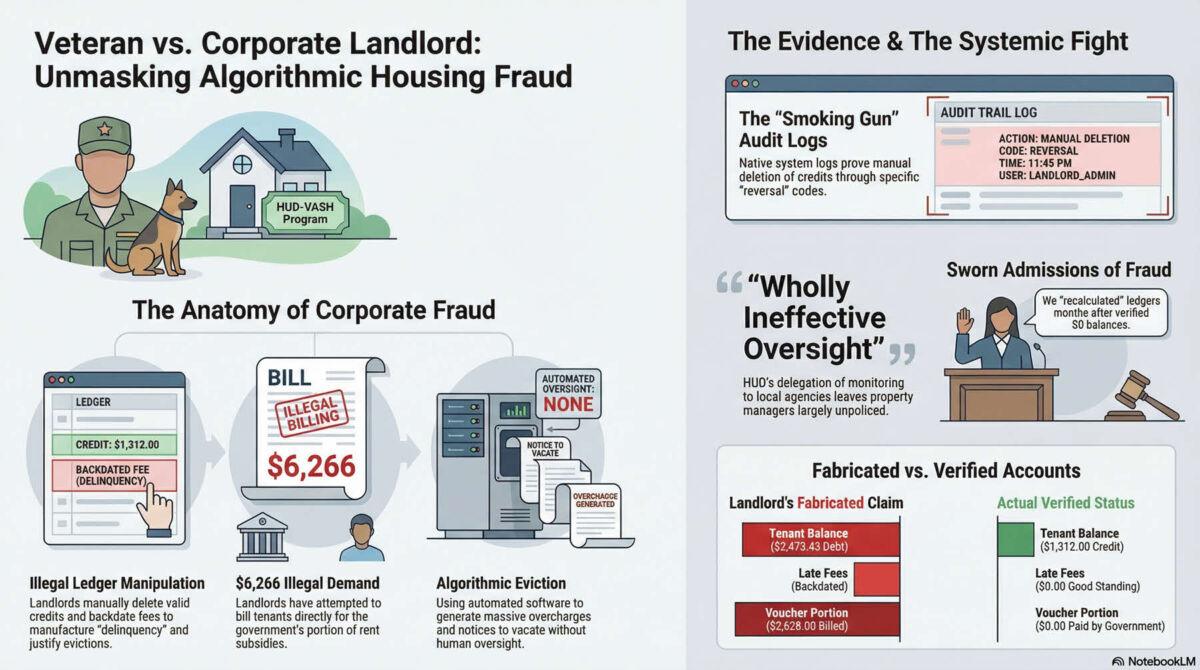
But today, that safety net has a massive, corporate-sized hole in it.
Across the country, multi-national property management companies are relying on automated, third-party billing software to manage tenant accounts. All too often, these opaque systems systematically overcharge tenants, fabricate debt, and issue computer-generated eviction notices—a practice increasingly known as “algorithmic eviction.”
Because federal oversight has broken down, the burden of fighting this software has fallen on the shoulders of individual, low-income tenants. This is the story of one disabled USAF veteran in Texas who refused to be algorithmically evicted—and ended up exposing a corporate housing machine.
The Trap: Phantom Debts and Erased Credits
For years, this disabled veteran maintained a flawless payment history at his apartment complex, managed by one of the largest corporate landlords in the country. Every month, his portion of the rent was paid automatically through the landlord’s mandated billing app.
Yet, year after year, the automated system would mysteriously generate massive phantom charges—sometimes up to ten times his actual rent. These phantom charges triggered automatic late penalties and terrifying Notices to Vacate. After months of stress and fighting, the charges would usually vanish without explanation, only to return the next year.
When the veteran formally reported this recurring billing abuse to the local housing authority, the corporate landlord’s system didn’t fix the error. Instead, it struck back.
Within days of his complaint, the property’s ledger was manually altered. A valid rent credit that had sat on the veteran’s account for half a year was completely erased. To bridge the mathematical gap and justify an immediate eviction, the system backdated late fees to closed accounting periods. Overnight, a tenant with a perfect payment record went from having a $0 balance to facing thousands of dollars in fabricated debt.
For a detailed deep dive into the forensic accounting, BILT audit logs, and court filings proving exactly how this ledger was altered, visit homepit.com/case-summary
The Systemic Void: Where is the Government?
How does a multi-national corporation get away with literally rewriting financial history to evict a disabled veteran? The answer lies in a massive failure of federal oversight.
Originally, the Department of Housing and Urban Development (HUD) was responsible for monitoring property managers to protect tenants from abuse. Today, HUD has largely delegated that oversight to local public housing agencies. These local agencies often lack the funding, authority, or technical expertise to audit complex corporate software.When corporate landlords present a computerized ledger claiming a tenant is in debt, local housing authorities and eviction courts usually just assume the software is correct. The burden of proof is entirely shifted onto the tenant—who is almost always too poor, too disabled, or too intimidated to fight a corporate legal team. Corporate landlords rely on this dynamic because it is highly profitable and rarely challenged.
The Pushback: A Tenant Who Kept the Receipts
The landlord expected this veteran to quietly fold or pay the fabricated fees to save his housing voucher. They picked the wrong tenant.
Instead of backing down, the veteran took the corporate landlord to court pro se (without a lawyer). He secured a Temporary Restraining Order from a District Judge to stop the eviction dead in its tracks. He escrowed his rent money with the court to prove his good faith. He then brought in an independent, licensed real estate expert who testified that the landlord’s retroactively altered ledger violated standard property management practices and HUD rules.
The Fight Belongs to the DOJ
This ongoing lawsuit exposes a glaring truth: no tenant should have to become a forensic accountant and amateur litigator just to survive in a federal housing program.
By weaponizing automated accounting software, corporate landlords are actively undermining the integrity of the federal housing program for our nation’s veterans (our heroes) and terrorizing the vulnerable populations it was designed to protect.
Civil lawsuits like Stuart vs Brookfield Properties are the tip of the spear, forcing corporate accounting practices into the permanent public record.
But until the Department of Justice and the HUD Office of Inspector General step in to audit these third-party billing platforms at scale, the safety net will remain broken. Until then, the lesson for tenants everywhere is clear: keep your receipts, monitor your ledgers, and never be afraid to fight back.