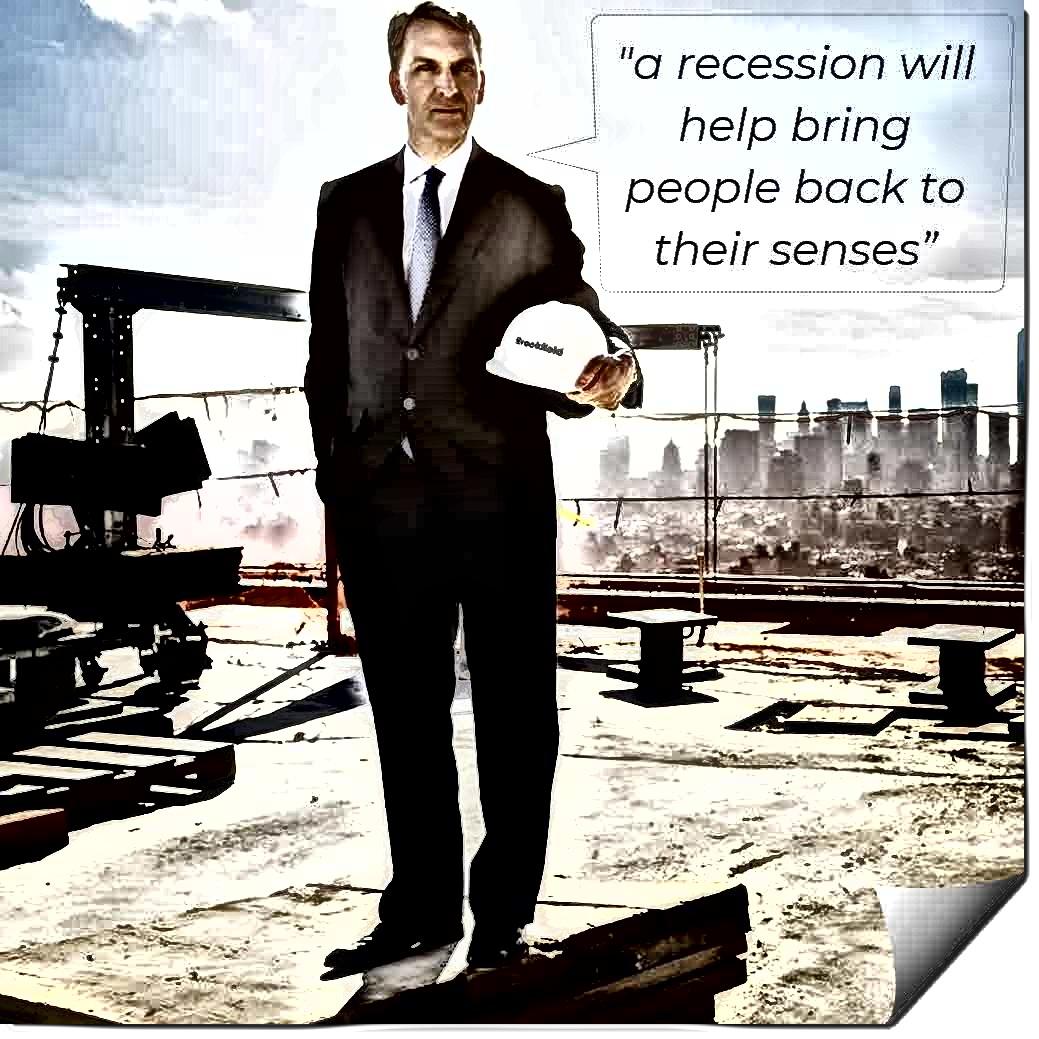
Why Bruce Flatt’s Remarks Should Give the Public Pause
Most people assume that large corporations — especially those managing something as intimate as housing — operate with a baseline of restraint: careful accounting, reputational awareness, professional distance, and at least a nominal concern for the people affected by their decisions.
That assumption is increasingly wrong.
A May 2023 profile of Brookfield CEO Bruce Flatt in The Sunday Times offers a rare, unfiltered look inside the mindset of one of the most powerful figures in global real estate. The article is not hostile. It is not investigative. It is admiring in tone.
And yet, when read carefully, it leaves an unmistakably creepy impression.
Not because of what Flatt is accused of — but because of what he casually reveals about how he sees the world.
When Suffering Becomes a Management Tool
Flatt’s most striking remark is his assertion that “a recession will help bring people back to their senses.”
This is not framed as regret. It is framed as benefit.
Economic pain, in Flatt’s telling, is useful. It corrects behavior. It restores discipline. It reasserts control. In his worldview, hardship is not something to mitigate — it is something to leverage.
That attitude may sound abstract. But it matters enormously when applied to housing, where “discipline” translates into:
- Rent pressure
- Fees
- Threats
- Displacement
- Stress inflicted on people with the least ability to absorb it
The chilling part is not the statement itself — it’s how comfortable he is saying it.
A Joking Glimpse at Monetization Without Limits
At one point in the article, Flatt jokes that tenants running 24-hour laboratory experiments should be charged double rent. The remark is delivered lightly to laughter.
But it reveals something profound:
An instinct to monetize without regard to purpose, impact, or humanity.
This is the mindset that filters down into corporate culture — where every interaction becomes transactional, and every human situation is reframed as a billing scenario.
Extreme Wealth and the Loss of Reality
Flatt’s comments throughout the article suggest a man who has lived at such altitude for so long that ordinary human experience has faded from view.
Work-from-home confuses him. Economic anxiety is dismissed as a “bad habit.”
People struggling are described as needing to be “brought back to their senses.”
This is what extreme wealth and power often do: They create an alternate reality in which pressure is invisible, consequences are distant, and suffering is theoretical.
That detachment is not malicious — but it is dangerous.
How This Mindset Becomes Corporate Culture
Corporate culture flows downhill.
When leadership views:
- Hardship as corrective
- Pressure as productive
- People as inputs
- Errors as acceptable losses
The organization follows suit.
This helps explain why Brookfield and similar Wall Street–backed landlords are repeatedly accused of:
- Squeezing profit from vulnerable populations
- Treating errors as “noise”
- Ignoring whistleblowers
- Retaliating when challenged
- Using opaque systems to overwhelm individuals
Not because every employee is cruel — but because the culture rewards indifference.
Why the Public Is Being Caught Off Guard
For decades, corporations cultivated an image of:
- Careful governance
- Rock-solid accounting
- Reputation sensitivity
- Professional restraint
Private equity–backed firms are quietly dismantling that expectation.
They are less visible, more insulated, more aggressive.
And less concerned with public approval than with internal returns.
Politics is only beginning to respond, regulators lag behind.
Courts are increasingly where these realities surface.
An Eye-Opening Moment — If We’re Willing to Look
The value of The Sunday Times article is not in what it accuses Bruce Flatt of.
It is in what it reveals, unintentionally, about how one of the world’s most powerful housing owners thinks.
Read closely, and the culture becomes visible. And once you see it, the stories coming out of corporate housing no longer feel like anomalies.
They feel inevitable.
Source
Oliver Shah, “Brookfield’s Bruce Flatt: A recession will help bring people back to their senses,”
The Sunday Times, May 7, 2023.
(PDF on file)